
How to support work standardization in the company?
Creating a good job manual is a serious undertaking. Someone has to go through the process step by step, capturing all the important details, and writing them down in a way that's understandable to someone doing it for the first time. This takes time, knowledge, and commitment.
Instructions at the workstation aren't enough. What else helps employees follow them?
The problem arises later. The instructions are posted at the workstation, the employee has read them, and received training. Then the daily work begins, and bravado, rush, and routine creep in. Some steps seem unnecessary because "I've always done it this way and nothing has ever happened." Others simply slip by because no one has told them this particular step is critical.
Creating instructions alone is only half the battle. The other half is creating conditions in which following them is easy, natural, and doesn't require constant memorization from the employee.
Instructions in a visible place
Before anything else, the manual must be where the employee needs it—not in a binder, not on a computer across the hall. It must be at the workstation, at eye level, easily readable without bending down and searching for it.
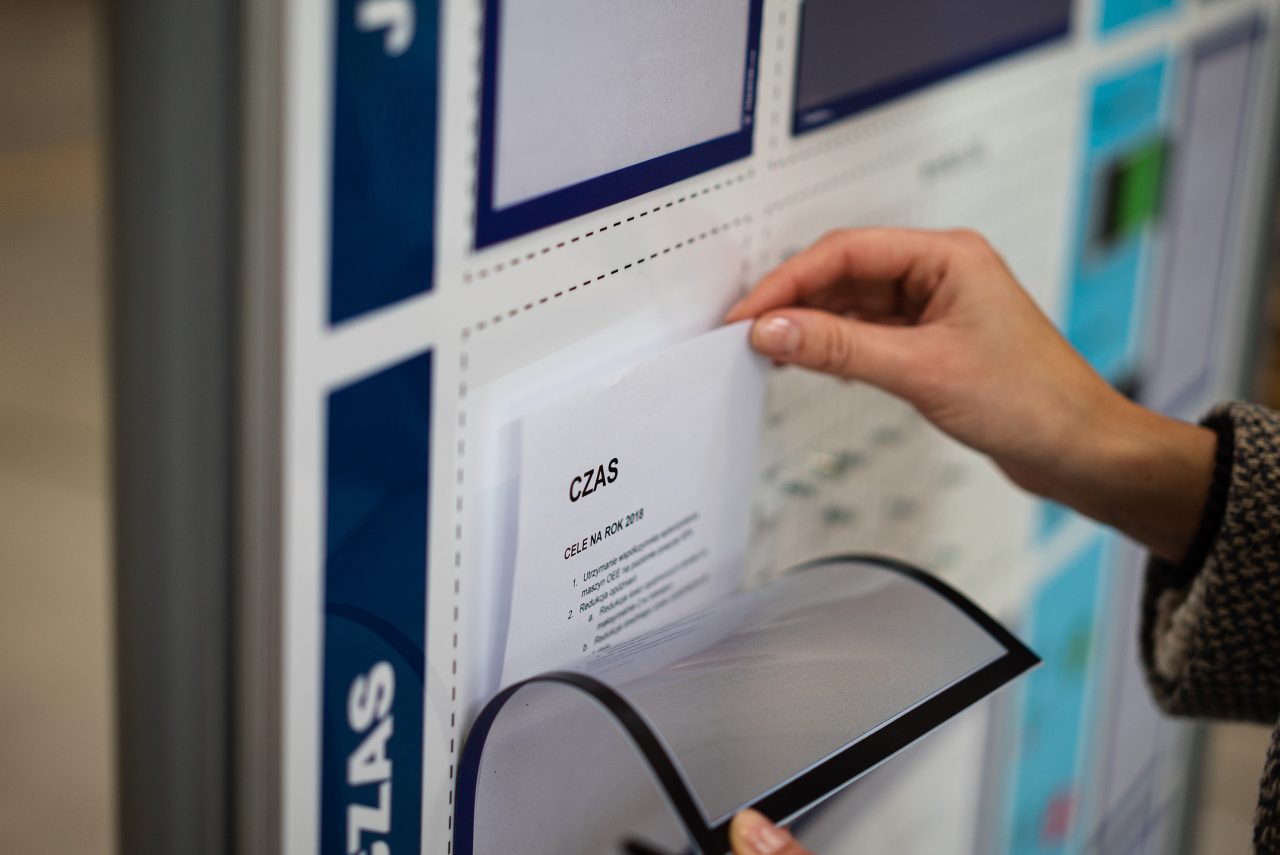
5S openable frames allow you to place documents at your workstation in a way that protects them from dirt and damage, while also allowing for quick replacement when the manual is updated. Simply open the frame, replace the page, and close it. No removal, no adhesive, and no trace of the previous version left behind.
This is especially important where processes are changing, because outdated instructions are worse than none at all. They give employees a false sense of doing the right thing.
A space that resembles an employee instead
Good workspace organization means that employees have to remember as little as possible. Not because they have poor memory, but because attention spans are limited during intense work, and any additional cognitive load increases the risk of error.
Shadow boards solve one of the most common problems: tools ending up in random places, only to be searched for days later. A shadow board outlines what's where. When a tool is returned to its place, the shadow disappears beneath it. When it's gone, the shadow remains, making it immediately clear what's missing. In intense work environments where no one stops to consider where to put a wrench, a shadow board works without any effort on the part of the employee.
Occupational health and safety stickers and signs at specific work stations remind employees of easily overlooked elements: the need to use protective equipment, the order of operations, and hazards that aren't immediately obvious to someone new. A warning sign on a machine works even when the employee is tired, in a hurry, or simply thinking about something else.
Marking process steps directly at the workstation is particularly useful for infrequent tasks, such as changeovers or maintenance. Numbered stickers or plates on specific machine components guide the operator through the subsequent steps without the need to constantly consult the manual. Employees navigate space, not memory.
Labels on tools and materials eliminate another source of error: uncertainty about which item is used for what, which tool is intended for which operation. A pocket with an information card next to the container or a tag attached to the tool provide the answer right where the question arises.
Who is trained and verified by whom?
The instructions at a workstation tell you how to do something. But they don't say who actually understands it and who can do it independently. This information is equally important, especially when several people work at the workstation on different shifts.
Acompetency board at a workstation or line shows who is trained and at what level. Who can work independently, who requires supervision, and who is willing to teach others. Together, the instruction and competency board form a coherent system: one describes how, the other confirms that the person understands and can apply it.
The manual is a starting point, not a solution
Simply writing instructions and posting them at the workstation is necessary, but not sufficient. The conditions under which an employee is likely to learn and apply these instructions depend on how the workstation is designed and how the space around it is organized.
It's also worth remembering that the way instructions are delivered is just as important as their content. The TWI method, or Training Within Industry, provides a framework for conducting on-the-job training so that knowledge actually reaches the employee, not just the binder. If you want to implement work standardization comprehensively, from instructions to training, Leantrix conducts TWI and work standardization workshops based on real-world production processes.