
What is visual management for industrial companies?
In a manufacturing plant or warehouse, hundreds of small decisions are made every day. Where to put a component. Which way to walk to avoid stepping in front of a forklift. Are inventory levels within acceptable limits? Who's on which shift today? Is a machine operating as planned? Most of these decisions don't require a report or a meeting. They require one thing: quick, clear information in the right place.
Visual Management: What Does It Actually Mean?
Visual management is a way of organizing information in a space so that everyone working in it can assess the situation and make the right decision in seconds. While a well-designed space is more pleasant to use, it's not about aesthetics. The point is to ensure that the information is where the question is asked, and the answer is understandable without translation.
In practice, visual management covers everything: from colors on the floor and health and safety signs on the walls, through competence boards and instructions at workstations, to production boards with status magnets and rack markings in the warehouse.
Why sight is the fastest sense at work
Humans process visual information many times faster than text. A red color near a buffer zone is immediately understood: stop, something requires attention. The outline of a tool on the shadow board informs without words that a key is missing. A green magnet on the production board indicates that everything is OK at that position.
In environments where noise is high, the pace of work is intense, and attention is limited, visual information reaches when other forms of communication fail.
What does a visual management system consist of?
Visual management in an industrial plant operates on several levels simultaneously.
Marking the space
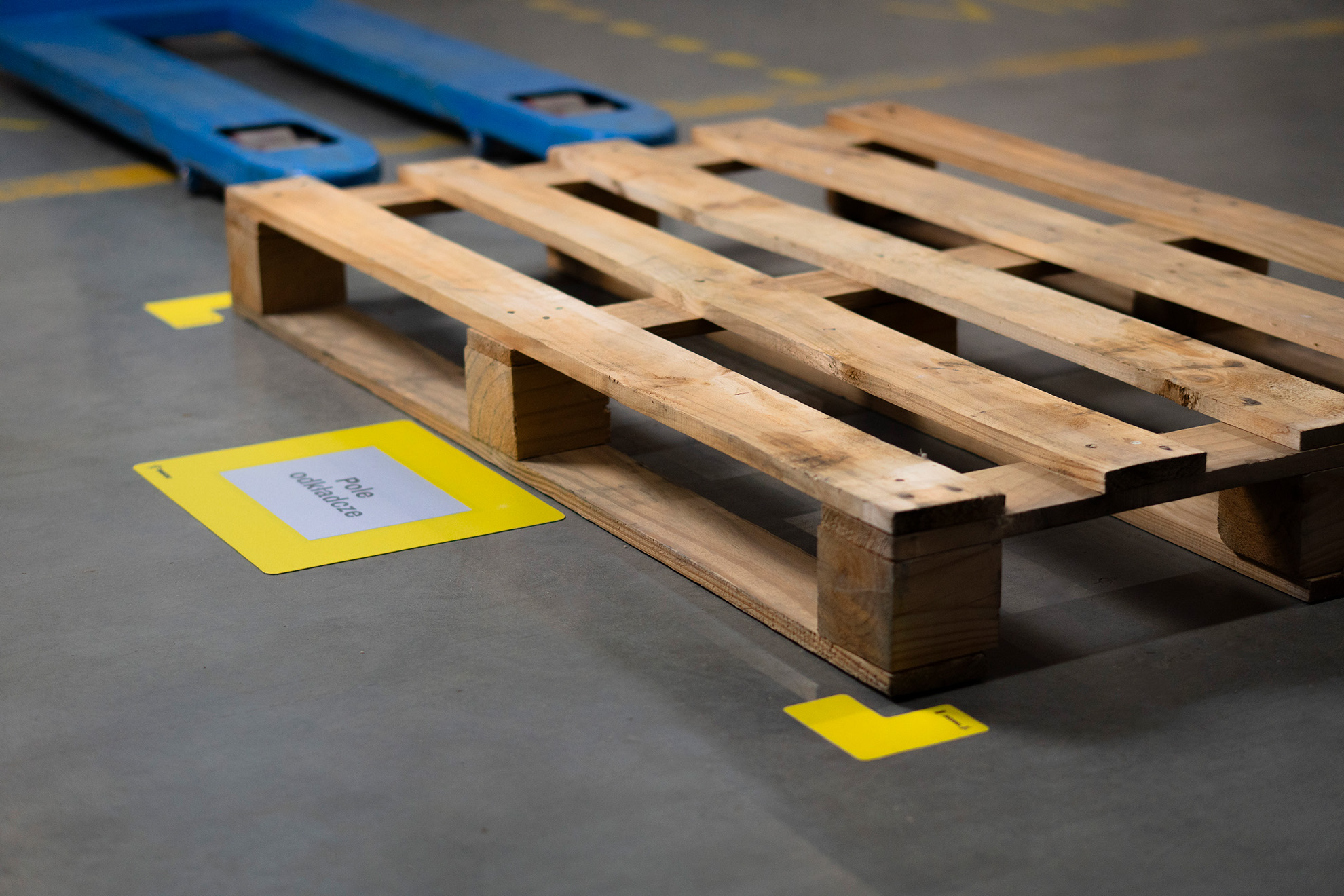
The floor is the primary and most important conveyor of information about who can move where and what belongs where. Transport routes, storage areas, pallet bays, pedestrian crossings, buffer zones with minimum and maximum levels – all of these communicate the structure of the space without words.
Vertical signage on walls, columns, and machinery complements the visual landscape with information that must be visible at eye level: mandatory and prohibitory signs, zone markings, signs identifying sectors and aisles, and evacuation routes. In high-ceilinged halls and warehouses, hanging signs are also available, visible from a distance, allowing users to locate the correct area without having to wander around the entire facility.
Workplace organization
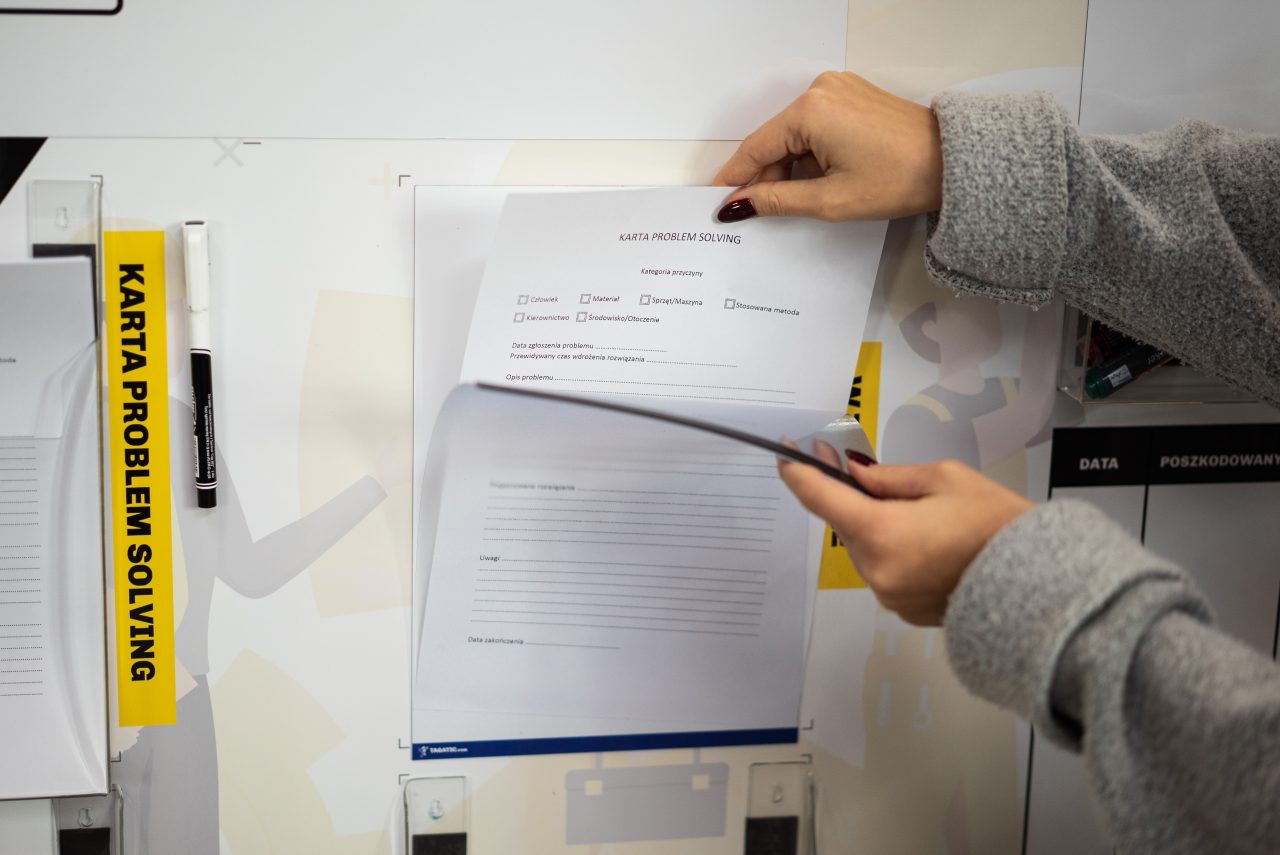
At the workstation level, visual management means that every tool has its place, every instruction is within sight, and information about the current order or process parameters is immediately available.
Shadow boards at production and assembly stations outline where everything is located. Document holders keep the current manual in a visible place, and changing it when an order changes takes seconds. Process step markings directly on machine components guide the operator through the next steps without having to consult a binder.
Information and status management
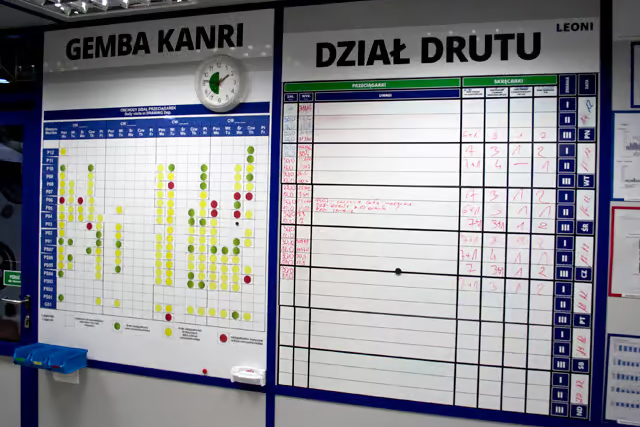
Above the job level is the shift and process level. Here, visual management answers questions like: how production is going, where are the problems, who is available, and what is planned for the next shift.
Dry-erase boards with status magnets provide managers and their teams with a shared overview of the situation in seconds. Green: everything is fine. Yellow: something requires attention. Red: a problem. Competency boards show who is trained for which task on a given shift and who can cover for an absent employee. Planning boards organize the schedule without having to log into the system.
Inventory and material flow management
At the warehouse and material flow level, visual management means that every container, every zone, and every storage location is clearly identified. Floor windows and magnetic pockets on racks maintain current location information. Marked min and max levels on buffer zones and containers let everyone know when it's time to react, without asking for status.
What does the implementation of a visual management system look like?
Implementing visual management is a process, not a one-time effort. It begins with understanding the space and the processes that occur within it.
Step 1: Mapping the space and identifying needs. Before the first tape is even on the floor, you need to understand how the space works: where people and machines move, where touchpoints and potential conflicts exist, where information is needed and where it's missing. This step often reveals problems that no one has explicitly addressed before.
Step 2: System Design. Based on the mapping, a design is created that defines what we want to improve and how we want to achieve it. Zone colors, signage layout, signage layout at workstations and production lines, aisle identification system, and location. The design must be consistent throughout the facility, otherwise it can be misleading.
Step 3: Production and implementation. Floor markings, stickers, boards, frames, magnets, and windows. Each element is manufactured for a specific project and installed in the location specified in the design. For large projects, implementation is carried out in stages to avoid disruptions to production.
Step 4: Team training. This is the most frequently skipped step, yet it determines whether the system will function the same way a year from now as it did on the day it was implemented. Employees must understand why the system works the way it does and how to use it. Without this, even the best-designed space begins to fall apart within a few months.
Why training is part of implementation, not an addition to it
Visual management is changing the way people work. New signage isn't just about new stickers; it's about new habits. An employee who's been putting a tool down for years won't change that overnight just because a shadow board appears. A shift manager who's never used a production board won't automatically start using it just because it's on the wall.
Changing habits requires understanding, and understanding requires training. Especially with large-scale implementations that change the way an entire facility works, investing in team training is a prerequisite for ensuring a return on the signage investment itself.
In this area, we collaborate with Leantrix, a company specializing in lean management training and implementation. Their workshops help teams understand the logic of visual management and build the habits without which the system only works as long as someone is watching over it.
What does a plant that implements visual management gain?
New employees become more familiar with the space and process because the space itself guides them. Picking and locating materials is reduced. Problems are identified more quickly because the process status is displayed rather than hidden within the system. Work standards are easier to maintain because they are visible at the workstation.
Visual management doesn't solve process problems. But it makes them visible quickly enough to address them before they become more serious.
Where to start?
There's no need to start with an entire facility. Just one production cell, one line, or a warehouse. A visual management system can be built gradually, starting with areas where the need is greatest or where the results will be visible most quickly.
If you'd like to assess where visual management can deliver the greatest value in your facility, we can conduct an audit and propose specific solutions tailored to your space and processes. Just start with a conversation.
Free Visual Management Audit