
Chaku chaku − organization of the production cell
The production process can be conducted in many ways. Work can be divided among multiple operators, each responsible for a specific step. A linear flow can be established. Alternatively, solutions derived from the Toyota production system, such as chaku-chaku, can be employed. This time, we take a closer look at this method, specifically in terms of its demands on space and workstation organization.
What is chaku-chaku?
Literally , "load, load." In practice, it's a method of organizing a production cellin which the operator independently guides the product through all stages of production, from the first to the last. Stations are arranged closely together, most often in a U- or Ω-, so that the paths between them are as short as possible. The operator moves from station to station, operating successive machines, and their pace is set by the tact.
A single operator may work in a single cell, but several may also work together, each completing all stages independently. No one specializes in just one operation.
Why such an arrangement instead of division of labor?
A division of labor, with each person responsible for a specific stage, seems logical at first glance. In practice, a problem arises that every production manager knows well: everyone works at a different pace. A buffer begins to accumulate at one workstation, while at another, an operator waits idle. Material stagnates, and time flies.
Rapidly handing off products to the next person also makes it harder to spot defects. If everyone is responsible only for their part of the process, an error in the first step may ripple through several subsequent steps before anyone notices it. An operator who manages the product from start to finish sees it differently and will spot deviations from the norm more quickly.
Chaku-chaku solves both problems simultaneously. Rhythm dictates tact, and responsibility for the product is indivisible.
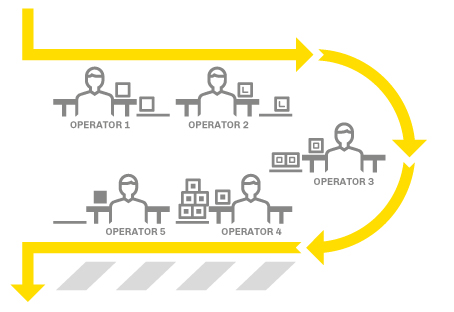
Stations with separate operators
Potential problems:
- More space needed to organize stations.
- Buffers and overproduction are building up, with workers working at a slower pace.
- Less time for error verification.
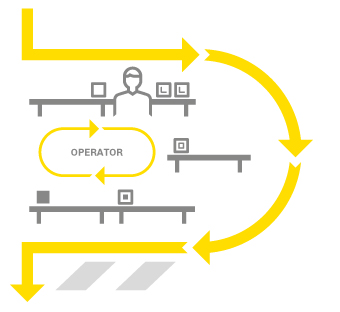
The chaku chaku method
- The employee passes through all the stations, which are very close to each other.
- Throughout the entire process, he is in contact with the product he is processing, so he is able to notice any imperfections.
- There is no room for overproduction here.
Several operators can work at one socket.
What does chaku-chaku say about a job position?
The method doesn't work in chaos. Every second an operator spends searching for a needed tool or instruction is wasted. In chaku-chaku, this waste is immediately apparent, because the workflow is strict and any disruption halts it.
Therefore, the method places very specific requirements on the organization of the workplace:
Every tool has its place and always returns there
In a method where the operator performs the same movements over and over again, the tool must always be where the operator expects it. This prevents a situation where a tool is set aside and then forgotten. Then the search begins, slowing down the process, and causing oversights.
A shadow board at the workstation solves this problem. The outline of each tool is painted on the board, indicating its location. When a tool is removed from the board, a shadow appears, immediately revealing what's missing. When the tool is returned to its place, the shadow disappears beneath it. The operator doesn't search, doesn't ask questions, and doesn't lose rhythm. The board layout can be customized to suit a specific tool station and the set of tools working there.
The instructions must be visible without searching
Machine parameters, the sequence of operations, and information about the current order must be immediately available. A document holder at the workstation, with an anti-reflective surface and space for a replaceable insert, ensures that the manual is always in the right place, right in front of the operator. Changing the order? Simply replace the sheet.
Clearly defined storage area
An item exits the machine and must land in exactly the same spot every time. If the storage area isn't clearly marked, the operator must decide where to place it each time. It's a fraction of a second, but over the course of a day, those fractions add up.
Floor markings and windows describing the zone's contents eliminate this decision. There's only one space, and everyone knows it.
Why the organization of space determines whether the method will work
Chaku-chaku is demanding. There's no room for improvisation. The rhythm of the work is predetermined, and any deviation from it is immediately apparent.
This is actually good news. The method itself enforces order. If something isn't working, it lets you know immediately. In this sense, chaku-chaku is one of the best tests of whether your workstation organization is truly well-thought-out or just looks good in photos.
If you want to learn more about how to prepare a production cell to work according to lean principles, Leantrix conducts training courses that combine theory with workshops on a real process.