Lean Management – what is it and how does it work in practice?
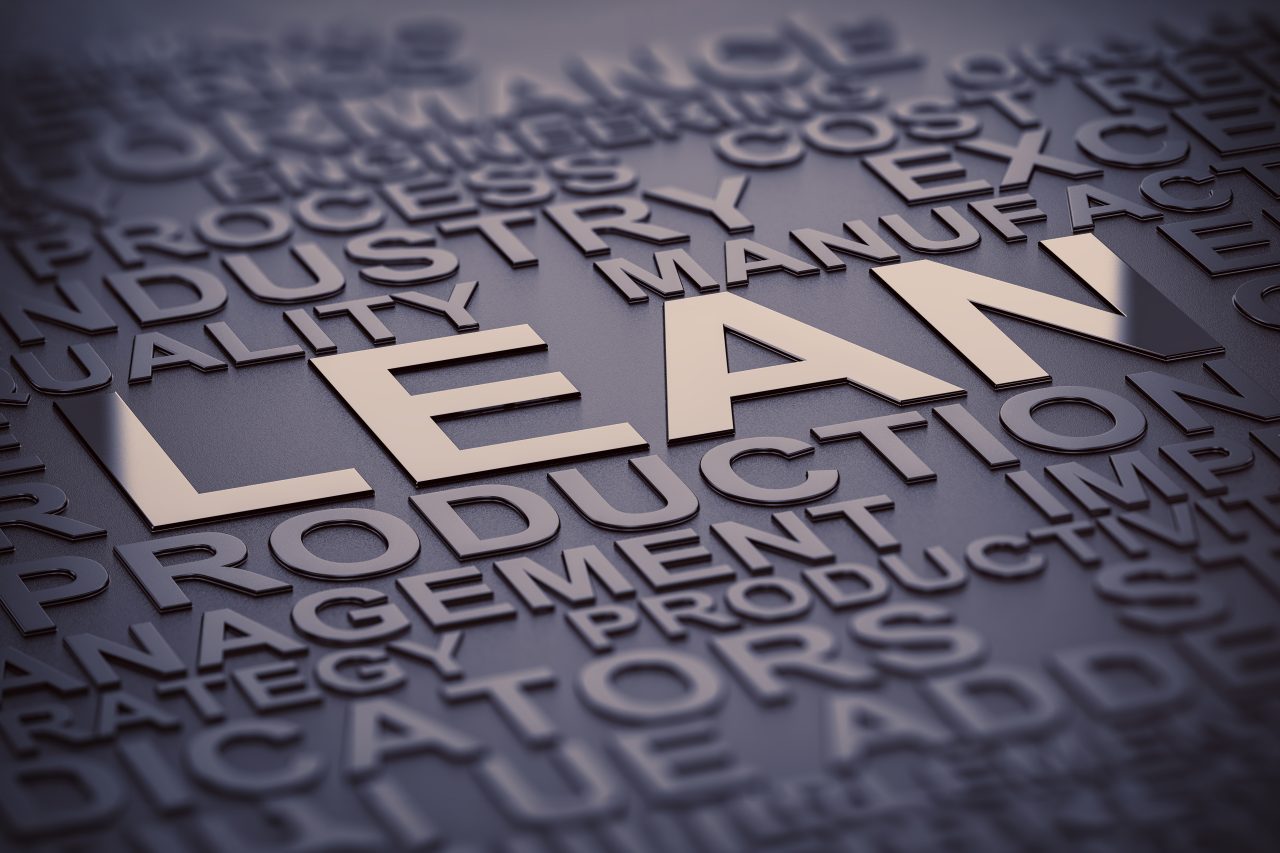
Do you manage a production floor and feel like you're putting out fires faster than you can prevent them? Are employees unsure what to do when the line stops? Is every day a struggle with downtime, shortages, and information chaos? If any of these situations sound familiar, you probably need Lean.
What is Lean really?
It is a management approach that aims to eliminate waste, i.e. anything that consumes time, money and energy without creating any value for the customer.
It stems from the Toyota Production System (TPS), which transformed the way we think about production in the second half of the 20th century. Its creators recognized that in most processes, only a few to a dozen percent of time actually creates value. The rest is spent waiting, overproduction, unnecessary transportation, and error correction. It provides tools to gradually reverse this proportion.
Where does waste hide?
Lean talks about seven classic types of waste, called muda:
- Overproduction – producing more than the customer or the next step in the process requires.
- Waiting – people and machines waiting for material, information or a decision
- Unnecessary transport – unnecessary movement of materials between stations
- Over-processing – performing operations that the client does not need
- Inventory – an excessive buffer of materials or semi-finished products that ties up cash
- Unnecessary movement – the employee searches for tools, goes for information, reaches too far
- Defects – errors, omissions, corrections, complaints
Lean teaches you how to spot them and how to systematically get rid of them.
What does it look like in practice?
Theory is important, but Lean only works when it leaves the workshop, not the training room. Here are some concrete examples.
5S – order that changes the way we work
The five-step system (Sorting, Systematizing, Cleaning, Standardizing, Self-Discipline) organizes the workspace so that every employee (even a new one) knows immediately where everything is, what is the norm and what is a deviation from it.
A good 5S implementation is visible at first glance: marked storage areas, clear communication zones on the floor, boards with information about the station status.
Visual Management – managing what you see
One of the key principles of Lean is that problems should be visible. If something is wrong, it should be obvious without having to ask, search the system, or wait for a report.
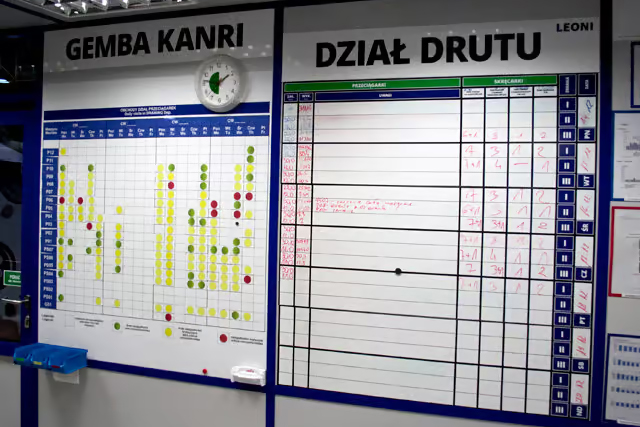
This is what visual management is all about. Production boards, team dashboards, floor markings, color schemes—all of these help the facility "speak" for itself.
Gemba Walk – Management at the Line
Most production problems look different in Excel than they do at the machine. A manager shouldn't be managing from behind a desk. They should be walking the floor, observing processes, talking to employees, and looking for deviations from the norm. This is the Gemba Walk.
Standardization of work
Without a standard, there is no improvement. Lean places enormous emphasis on creating clear, understandable instructions and procedures so that every change and every line achieves a repeatable result. A standard is a reference point, without which you don't know whether something has improved or deteriorated.
What tools support implementation?
Lean training knowledge is the first step, but for this philosophy to work in practice, the production floor must be ready. At Tagatic, we design and produce visual management solutions that help translate knowledge from the training room to the factory floor.
Visualization boards
The heart of every production area, Tagatic wall and mobile boards serve as a hub for information about results, issues, plans, and status. We can design them for specific processes, with sections for PDCA, quality reports, team metrics, and production plans.
Competency table
At a glance, you know who can operate which machine, who is undergoing training, and who has achieved full competence. The competency dashboard eliminates guesswork and allows for better planning of replacements and employee development paths.
Floor markings and 5S zones
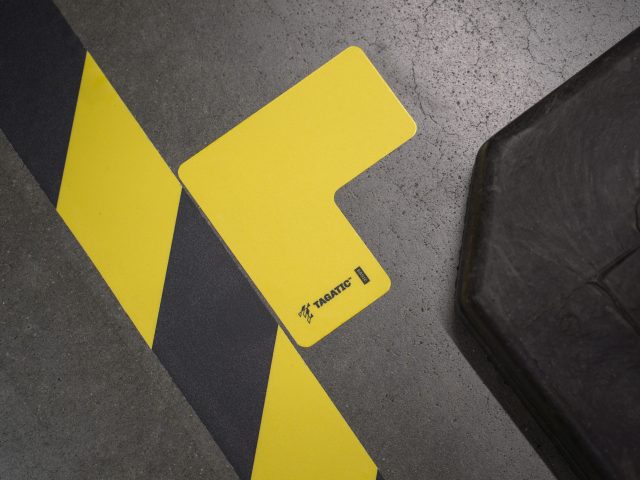
Floor tapes, stickers, and markings for storage areas and pedestrian crossings are the foundation of visual order in the production hall. Our products are tested in real industrial conditions to withstand intensive use.
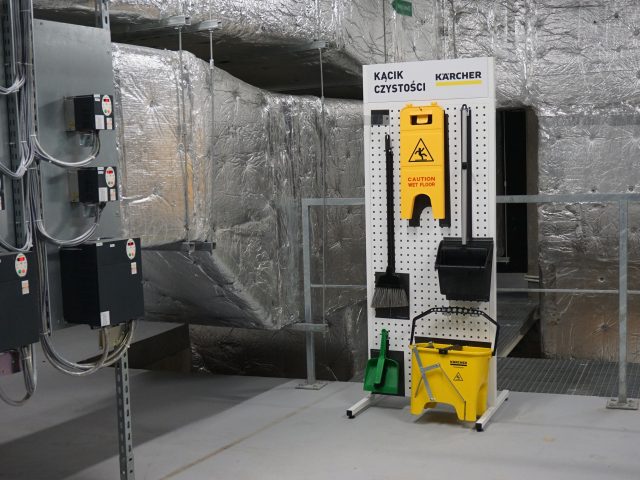
Shadow boards and cleanliness corners
Every tool has its place. Shadow boards and cleaning corners are a simple way to maintain 5S standards and immediately detect any missing items.
Dry-erase graphics for boards
Standardization, PDCA, Gemba Walk, Problem Solving – we have ready-made graphics for each of these tools, or we design them custom-made. This makes boards not just decorative elements, but real work tools.

Want to learn Lean from scratch?
Successful Lean implementation begins with effective training. In this area, we highly recommend the specialists at Leantrix, a company specializing in the practical implementation of Lean Management in manufacturing and service organizations.
Leantrix offers Lean training and implementation projects across the entire spectrum: from 5S and SMED, through TPM and VSM, to TWI (Training Within Industry), Hoshin Kanri and Lean Six Sigma.
If you are looking for reliable Lean training for your team, be sure to check out their offer:
Lean is not a project with a deadline
Lean doesn't end with 5S implementation or the first training. It's continuous improvement. It's a cycle of observation, standardization, and improvement. Every good production manager knows that work on a process never ends.
Have questions about signage or visual management for your facility? Contact us.