
Lean Management Conference: The Roadmap for Lean Summit 2027
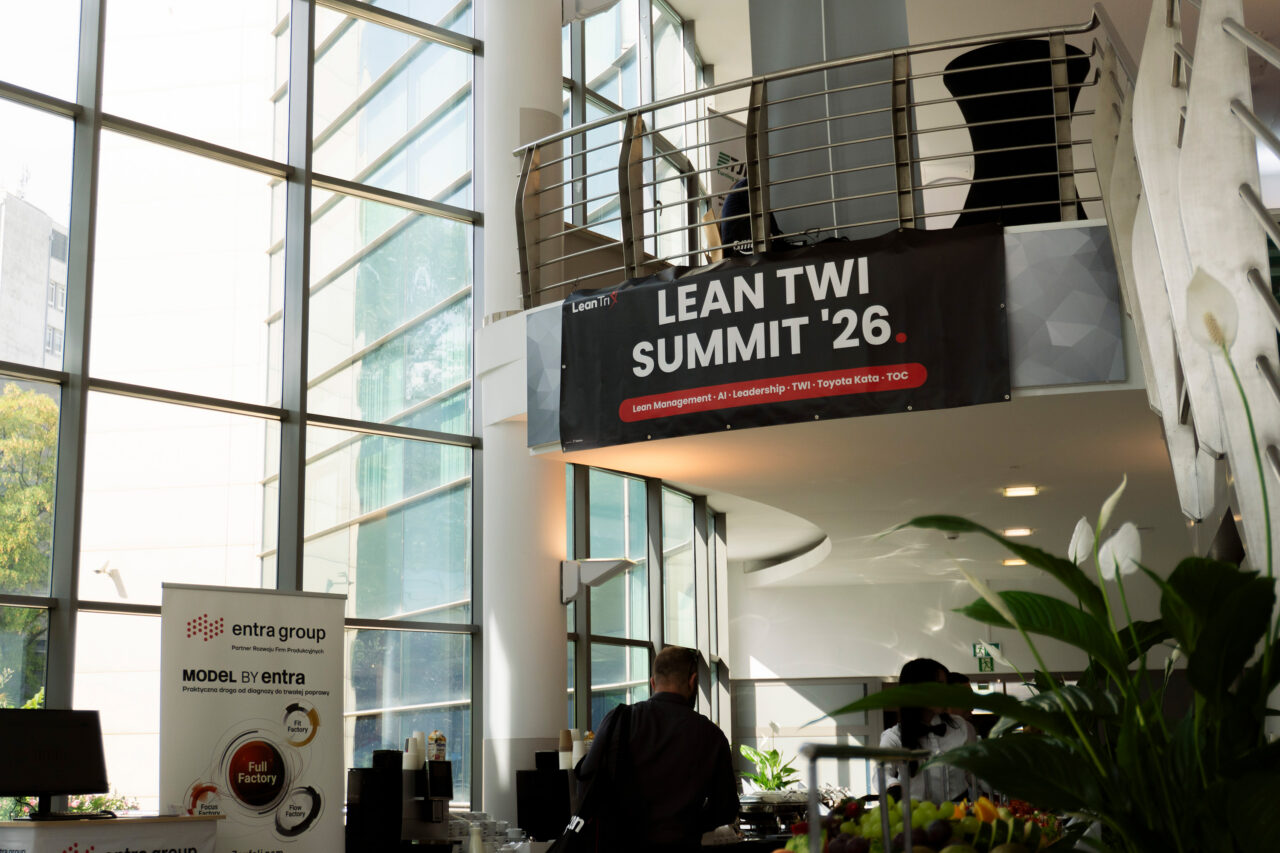
Two days, over 50 speakers, and five rooms operating simultaneously. It's easy to listen to a bit of everything at Lean Summit over the course of two days and return without a plan of where to begin. We'll advise you on how to prepare for the 2027 edition and what to do after your return to ensure the conference translates into changes within your company.
Tagatic × Leantrix Partner Article
Lean Management Conference seen from two sides
At this year's Lean Summit, we played two roles. As a Gold Partner, we had a booth and spoke with attendees. Before the doors opened, we prepared signage for the event.
Thanks to this, we saw the conference from two perspectives: from the perspective of the attendee, who has two days and dozens of presentations to choose from, and from the perspective of the venue, where several hundred people have to efficiently get where they want to go.
The next edition will take place in June 2027, once again hosted by Leantrix. Below, we've gathered tips from both perspectives.
Lean Summit 2027 in Brief
When and where: June 15–16, 2027, Congress Center at Centennial Hall in Wrocław.
This is the fourth edition of the conference, formerly known as the Lean TWI Summit. Organizers expect over 1,100 attendees. For comparison, the 2026 edition attracted 657 attendees, and the event received an average rating of 9.33 out of 10.
The program includes over 50 speakers and over 70 presentations and workshops in five parallel blocks. Topics are divided into four tracks: People, Processes, Technology, and Lessons Learned, which are lessons learned from implementations that didn't go as planned.
The main stage will feature performances by Jeffrey K. Liker, author of "The Toyota Way," Rami Goldratt, expert in the Theory of Constraints, Ian Glenday, two-time Shingo Award winner, Robert Korzeniowski, and Marcin Prokop. Representatives from companies such as Amazon, Toyota Motor Manufacturing Poland, PepsiCo, Hitachi Energy, and Saint-Gobain will also share their experiences.
The organizers announce that there will be no sales presentations on the main stage, in workshops, or in case studies. The full program and current pricing can be found on the Lean Summit website.
Before the conference: choose the path to your problem
Five parallel blocks mean you won't see everything, so it's worth deciding what you're looking for before you go.
The easiest way to start is with what is most bothering your company today.
Event Paths:
People
if the problem is turnover, onboarding new people or the role of leaders
Processes
if changeovers, material flow or quality,
Technology
if you are considering digital instruction or the use of AI,
Lessons Learned
if you are in the process of implementation and something is not working as expected.
If several people from your company are going, share your experiences. Half an hour on the evening of the first day is enough to tell each other what was most interesting.
Plant visits: what to look for?
Before the conference, starting in March 2027, Leantrix will organize free benchmarking visits for registered participants. Approximately ten are scheduled, including visits to Amazon, PepsiCo, and Wago facilities.
In someone else's factory, it's easy to focus on the machines and metrics. We also always look at the space, because it says a lot about how the plant is actually performing. Here are a few things to consider:
-
Can you understand the floor without a guide?
Try to guess where the wheelchair path is, where the aisle is, and where the pallet space is before someone explains it to you.
-
How are intersections marked?
These are places where pedestrian traffic meets strollers, so it's clear how seriously the company takes safety.
-
Is the information on the boards up to date?
The date on the scoreboard says more than the board itself.
-
Where are the instructions hanging?
At your workstation, at eye level, or in a binder in the manager's office?
-
What does the marking look like after many years?
Worn corners and loose tape reveal which solutions have failed to withstand the wear and tear of traffic. This is valuable information before making your own purchase.
Take photos if your host allows. When you return, it's easier to show the team what's going on than to describe it.
On-site: Look for Trouble Stories
Leantrix announces that case studies at the conference will also highlight challenges, not just successes. This is good news, because stories of failure are usually the most revealing.
After the presentation, it's worth approaching the speaker and asking one question: What would you do differently if you were starting today? The answers rarely make it onto the slides.
Breaks and the partner zone are also good places for such conversations. At our stand, we'll be happy to show you examples of our completed signage and discuss what works well in the halls and what wears out quickly.
Behind the Scenes: How We Branded the Conference
For two days, the conference center becomes a sort of production hall. Several hundred people move between the rooms, registration, the partner area, and catering. Most are new to the building and have a few minutes to catch their next presentation.
We prepared signage for the entire event. Room doors were marked, and directional signs were placed in the hallways. Where a wall sign would be lost in the crowd, we hung signs from the ceiling. Banners and floor markings were also added.
The rules are the same as in a plant. Information must be placed where someone is making a decision, meaning at the fork in the corridor, not three meters behind it. It must be legible from a distance and understandable in a second. And the material must be chosen for the location: floor markings in a facility that returns to the owner after the event must disappear without a trace.
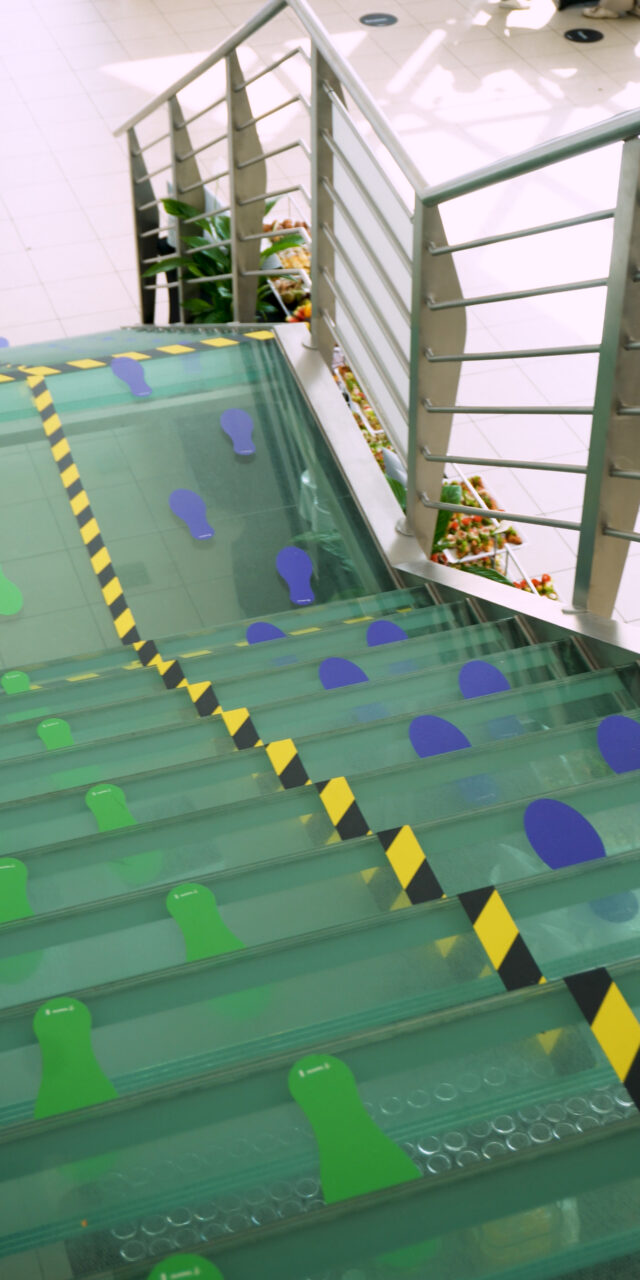
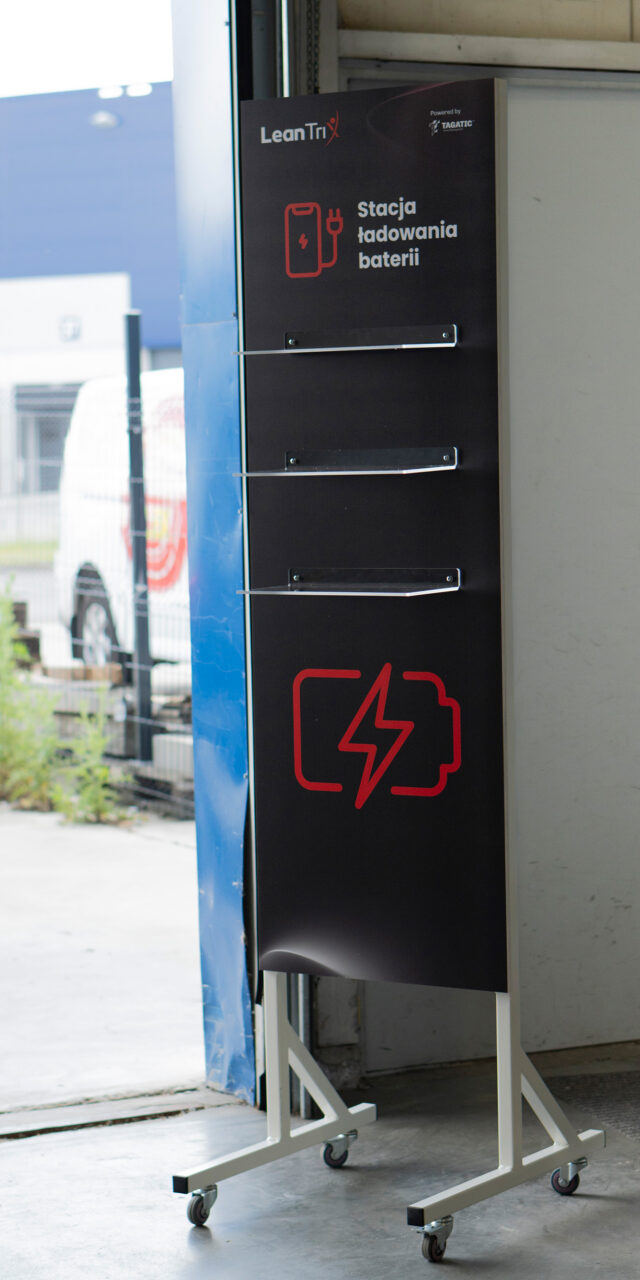
One thing went beyond simple signage. At the conference, phones and laptops were kept busy throughout the day: notes, photos, slides, contacts exchanged during breaks. That's why we set up a charging station where attendees could recharge their devices. We built it based on the structures we use in cleaning corners and health and safety stations. It was on wheels, so it could be moved wherever it was needed most.
This same mobility comes in handy on the shop floor. A wheeled corner can serve multiple areas or roll to a location where cleaning or retooling is in progress, instead of being stationary.
After returning: one thing to check
After two days of presentations, there are plenty of ideas left, but few decisions. The organizers are trying to remedy this with a simple tool. Each participant receives a Start-Stop-Continue card, on which they write down three things:
- Start: what will I start doing after the conference,
- Stop: what will I stop doing,
- Continue: what we already do well and it's worth maintaining.
This is a popular debriefing method, well-known from team meetings after a completed project. Its strength lies in its ability to transform general impressions into concrete resolutions. Instead of a note like "interesting presentation on changeovers," the sentence "we're starting to measure changeover time on line 2" appears.
It's best to update the card on an ongoing basis, after each speech that moved you. In the evening or on your way home, simply review it and choose one thing to put into practice over the next few weeks. One, even if you have many ideas.
We described how to plan the first two weeks of such a change in our article on choosing a Lean training course. The same plan will work well after the conference.
See you in Wrocław
Select your presentations, schedule a site visit, and return with one thing to check. And if it's time for changes to the hall after the conference, we'll help you implement them on the floor and walls.