
Minimum widths of transport roads

Managing in-plant traffic is a key aspect of ensuring safety and efficiency in any work environment. One of the fundamental elements of this process is the proper planning and design of transport routes, which includes establishing minimum widths.
Minimum road widths – meaning and regulations
Minimum transport route widths are dimensions that must be met to enable safe and efficient movement within a facility. They are crucial for preventing accidents and collisions, as well as for optimizing logistics processes.
These widths are regulated by occupational health and safety regulations and technical standards, such as PN-M-78010:1968P and PN-EN-349+A1:2012. They should be adapted to the specifics of a given workplace, the type and size of vehicles used, and the characteristics of the materials being transported.
Differences in dimensions for different types of roads
Depending on the type of traffic (one-way or two-way) and the type of transport (e.g., motorized or non-motorized), required road widths vary. It is important to include the space needed for pedestrians and the dimensions of the largest vehicles or loads in these calculations.
Examples of minimum widths
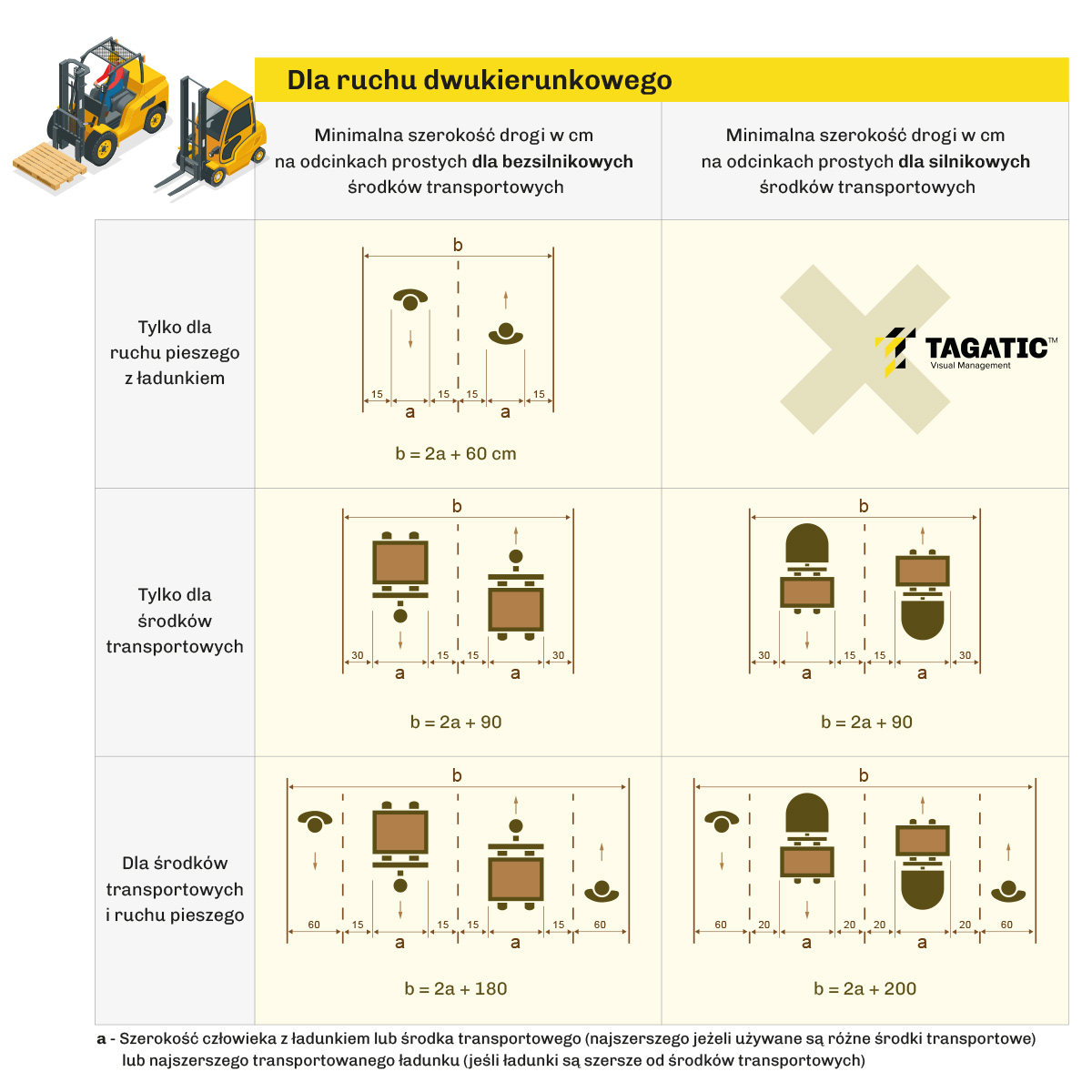
The minimum width of a road for loaded pedestrians is 30 cm more than the width of a person with a load, but no less than 120 cm. This applies to one-way traffic. For two-way traffic, this value must be doubled.
If we want to combine first-way traffic with vehicle traffic, the minimum road width must be 90 cm greater than the vehicle width for one-way traffic using non-motorized vehicles. For motorized vehicles, the width increases to 100 cm, and for two-way traffic, these widths must be twice as wide.
The tables below show the required minimum dimensions of roads for one-way and two-way traffic:

Complicated? Not necessarily!
Want to learn about required road widths and other traffic management guidelines, presented clearly and legibly? Download our e-book "In-plant Traffic Management." It covers basic traffic planning principles, road marking and width regulations, and safety issues. We offer practical tips and solutions you can implement in your facility!