
Documentation management in the workplace
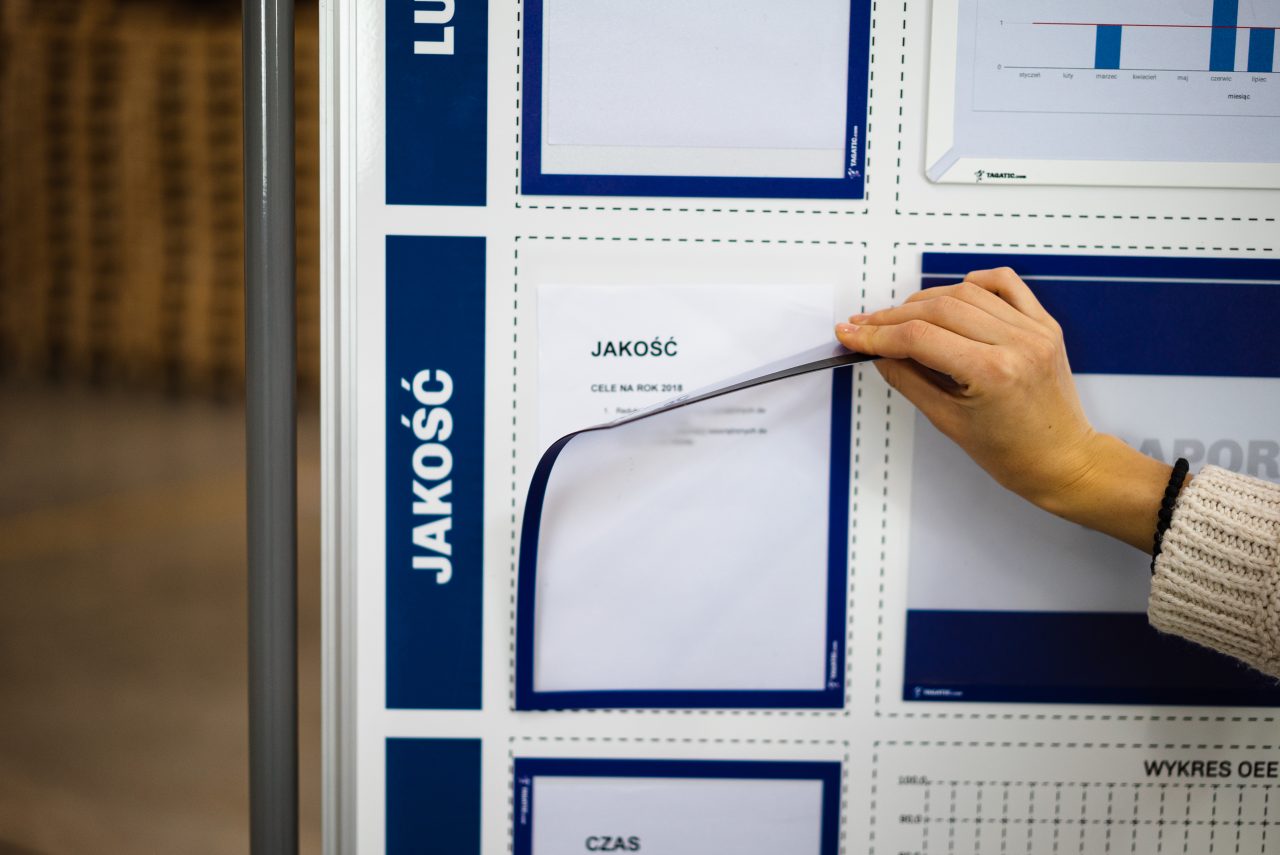
Effective management of documentation in the workplace is the key to increasing performance, elimination of waste of time and ensuring clear work standards. This issue applies to both industrial spaces, such as factories, warehouses and logistics centers, as well as office spaces. What tools allow you to effectively manage the circulation of documents?
Frames and windows for documents
In workplaces where access to specific documents is essential, document frames are an invaluable tool. They allow you to keep key instructions or documentation within easy reach. They ensure important documents are always at your fingertips, reducing the time it takes to find the information you need.
Frames can be permanently attached to the workspace using double-sided tape or attached with magnets, for example, when placed on a dry-erase board. Floor windows are also an alternative solution.
Visualization boards
Boards are an integral part of effective documentation management in the workplace. They can be used to present instructions or standardized worksheets. Boards with appropriate labels and information are legible, easy to understand, and memorable. They help maintain order and provide employees with quick access to key information.
We can use building walls or larger machine housings to position the boards. If these options are not available, it's worth using rotating and mobile boards.
Accessories
To maximize the board's usability, it's worth using additional accessories, such as the aforementioned magnetic frames or magnets. Remember, the goal of visual management is to reduce waste and streamline processes, so it's worth paying attention to every detail, even something like a place for markers near the board. Otherwise, employees will waste time searching for them—the very time we want to save.
Document Management in a Multilingual Environment
Effective documentation management in the workplace is especially crucial when working in a multilingual environment. In such a context, complex, multi-page instructions can be difficult for every employee to understand, and can be simply incomprehensible to foreigners. An excellent solution is pictorial job instructions, which describe step-by-step the actions an employee should perform. Modeled after the instructions found in IKEA products, they are clear, easy to understand, and memorable. This reduces the risk of errors by foreign-speaking or inexperienced employees.
Choosing the right visual tools that suit the specifics of a given work environment can significantly facilitate maintaining order, increase productivity, and positively impact work quality. The solutions we present are universal, but it's important to always choose them according to the specific needs and requirements of the workplace.