
Increasing production efficiency by correctly marking
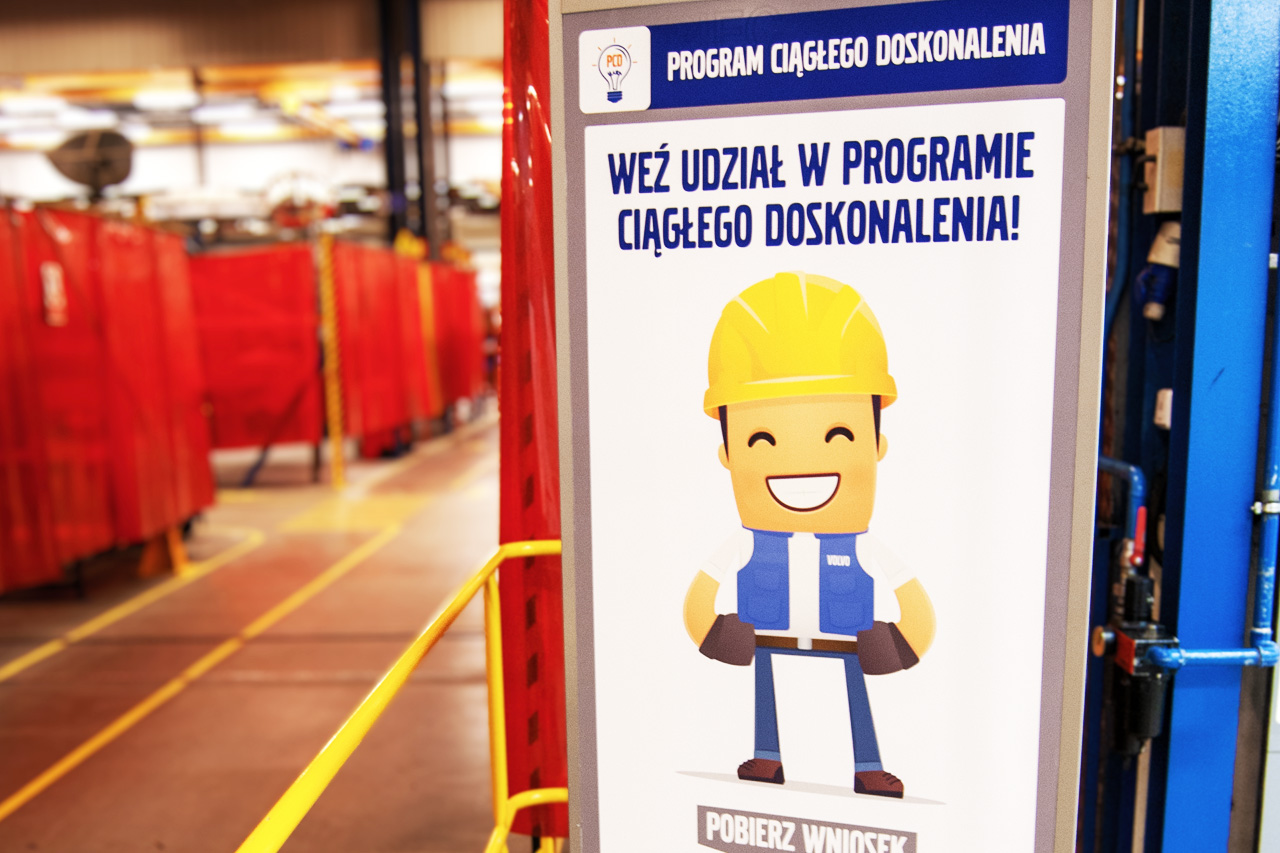
Signage in production halls and warehouses is a standard practice adopted by almost all companies. Such signage is primarily intended to increase employee safety by marking routes, hazardous objects, and reminding employees of procedures. However, a more comprehensive approach can yield significantly more benefits than simply increasing safety. Properly designed and selected signage can increase efficiency, streamline processes, and ultimately, generate savings.
Inventory management – marking optimal and minimum stock levels
The key to streamlining production processes is properly labeling optimal and minimum inventory levels. Some companies are opting for digital inventory systems, but such solutions can be supported, or even replaced, by simple labeling procedures. Possible solutions in this area include:
- stickers indicating the height that stacked loads should not exceed.
- stickers indicating the last pallet position that should be occupied by a given type of load.
These simple accessories, when used correctly, help you avoid waste by stocking up too much.
Another problem, also relatively easy to solve, is inventory shortages. In this case, the following solutions work well:
- stickers allowing to mark pallets which need to be replenished so as not to fall below the minimum levels.
- a board containing a table with a list of necessary raw materials, along with magnets illustrating stock levels.
Eliminating defects – pictorial job instructions
Effective production process management requires developing procedures that minimize the number of defective products and reduce the risk of errors. This is especially important when working in a multilingual environment. Complicated, multi-page instructions are difficult for every employee to understand, and can be simply incomprehensible to foreigners.
An excellent solution is pictorial job instructions, which describe step-by-step the tasks an employee should perform. Modeled after the instructions found in IKEA products, they are clear, easy to understand, and memorable. This reduces the risk of errors by employees who speak foreign languages or are inexperienced.
Another important element in the standardization of production processes are product correctness templates – the ability to apply and try on a product or semi-finished product to a template allows for the immediate elimination of defective products from the production cycle, without unnecessary delay and the risk of final error.
Save time – shadow boards and storage location labels
Small omissions translate into tangible losses. Sometimes we fail to realize that even the smallest waste of an employee's time has serious consequences for the entire plant. For example, time wasted searching for semi-finished products and tools. These may seem small and insignificant. If an employee spends five minutes searching for tools during an eight-hour shift, it may seem like a minor loss. But if we multiply this by a hundred employees in the plant, we're talking about a total loss of 250 hours—over one and a half full-time jobs. Multiplied by the minimum wage, each such five minutes can cost us over 5,000 złoty. What if there are two hundred employees? If they work two shifts? If they lose not 5, but 15 minutes? Losses start to add up to tens of thousands of złoty per month.
How can we prevent this? For example, with shadow boards at work stations. This solution allows employees to know exactly where to put down tools, ensuring they're always within reach. Combined with labels indicating the location of semi-finished products and pictorial instructions, we create the ideal workstation – one that saves time for line workers and foremen, who are less likely to need to provide assistance.
The simplest solutions are the most effective
When working with clients seeking comprehensive Visual Management solutions, we begin with an audit. This takes into account the specifics of the space, the nature of the work, and the company's internal procedures. The audit also identifies key issues that, while sometimes seemingly trivial, in practice impact the company's operations and results.
For example, one of our clients experienced several situations where, due to a misunderstanding, trucks departed before loading was completed. The solution we proposed was simple, and above all… effective. We prominently displayed pictorial instructions instructing the driver to… place the keys in a specially prepared basket. Keys were only released after confirming the loading was complete. As a result, we completely eliminated losses associated with premature departures.
This is what characterizes a good Visual Management System – simple and clear guidelines that influence key processes and improve the entire production process.