
Visual Management – the key to efficiency and savings in business
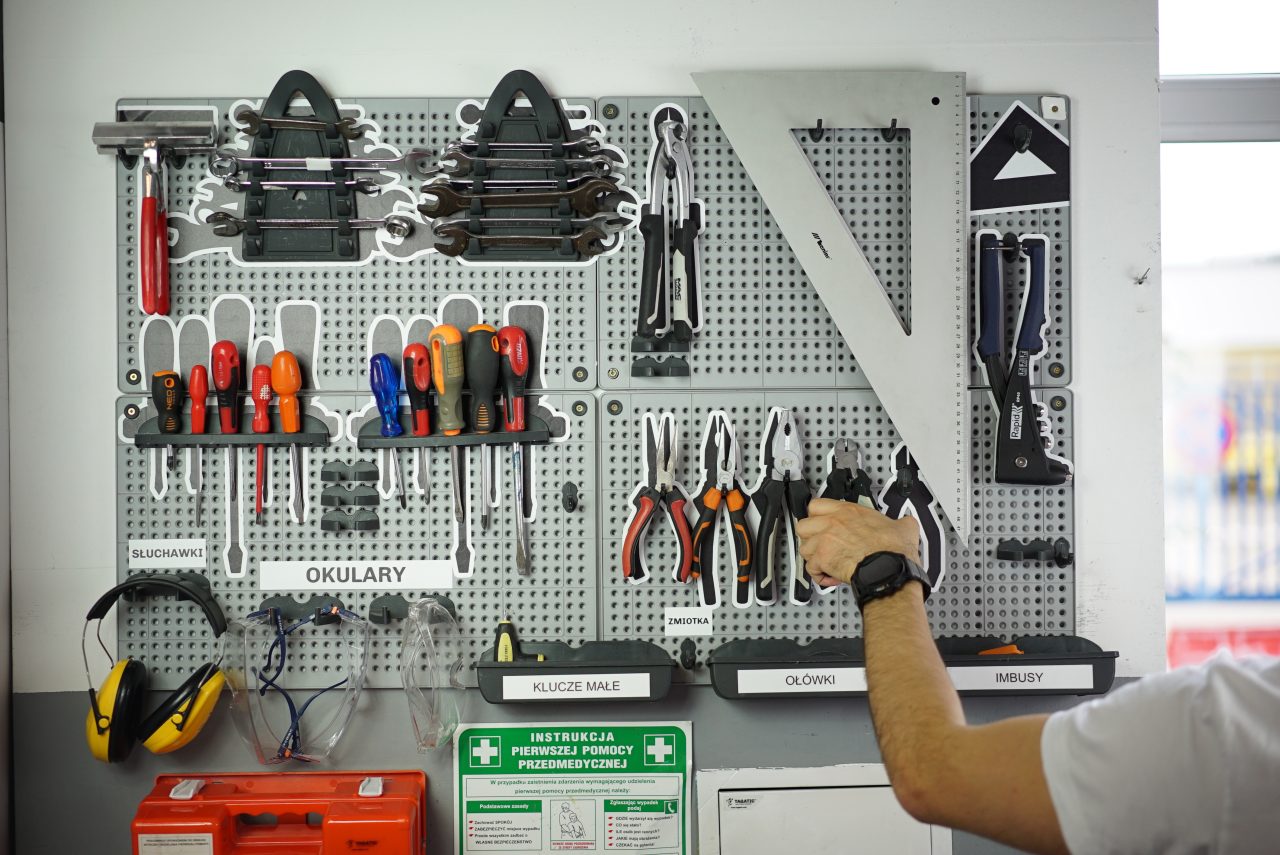
In an era of cost-cutting, savings, and efficiency, many companies are seeking tools that will increase productivity and eliminate waste. Visual Management solutions come to the rescue. These relatively inexpensive and effective methods help minimize waste and achieve a significant return on investment (ROI).
Visual Management and Lean Waste
According to lean management principles, it's important to constantly look for, identify, and eliminate waste in workflows. This waste can take the form of unnecessary operations, various irregularities, uneven or unjustified workloads, and underutilization of employee potential. Visual Management solutions are effective tools for minimizing the risk of waste and help implement the streamlining ideas of lean management experts. Here are some examples of undesirable situations from a process optimization perspective – along with ways to prevent them.
How to prevent overstocking with labeling
In companies that have not yet implemented digital inventory systems, maximum and minimum inventory levels can be effectively marked using simple Visual Management solutions. Depending on the type of product, maximum inventory levels can be marked with stickers indicating the height that stacked loads should not exceed, or with markings indicating the last pallet position that should be occupied by a specific type of load. Alternatively, a pallet can be marked, after which an order must be placed to ensure the minimum inventory level is maintained. An alternative is to implement a visualization-based communication system between those using a given product type and those responsible for its orders. For example, this could take the form of a table with a list of raw materials placed on a magnetic board, along with magnets in colors illustrating inventory levels. These are changed by employees depending on the quantity of a given product type in the plant.
Visual Management against process errors and quality defects
Visual Management solutions can also be successfully used to minimize the number of defective products and reduce the risk of errors in the production process. Recently, pictorial job instructions have become a hit with our clients – both for reducing the negative effects of turnover and for mitigating the consequences of language differences. Tasks to be performed at a specific point, described in a manner reminiscent of comics or IKEA assembly instructions, increase the likelihood of correct execution – even by inexperienced and non-Polish-speaking employees. Used in conjunction with product accuracy templates and clear labeling of raw materials to be used or excluded from further use, they significantly accelerate new employee onboarding and translate into fewer rejects.
Shadow boards and storage location labels to prevent time loss
On a plant-wide scale, and in the long term, time wasted by employees searching for semi-finished products and tools translates into thousands of zlotys in losses. Every five minutes wasted during an 8-hour workday by one person translates into approximately 5,000 zlotys in losses per month for 100 workstations – assuming the plant operates a single shift and offers line workers the minimum wage of 3,500 zlotys gross. In multi-shift operations and with higher wages, these losses multiply. Therefore, it's worth using shadow boards to help identify where tools should be placed; labels indicating the location of semi-finished products needed at a given workstation; and the pictorial job instructions mentioned above. This will save valuable time for line workers, but also for foremen, who will be less likely to be asked for assistance in finding the necessary tools and raw materials.
Fuller use of employee potential to improve processes
With well-developed job instructions, semi-finished product labels, and shadow boards, you can increase the productivity of employees performing tasks within existing processes, increasing the percentage of time they spend creating added value. However, to continuously improve plant operations, innovation is also necessary. According to Lean/TPS principles, the best source of inspiration for organizational changes at workstations comes from the people performing the tasks. Therefore, employee suggestion systems are often implemented in plants. However, they are not always effective. At one of our clients, the procedure for employee improvement submissions was described on several A4 sheets of paper next to the idea box. The number of suggestions was close to zero. When, at the client's request, we presented the content in the text as an eight-scene infographic with two-sentence descriptions for each illustration, the number of submitted improvements increased by several hundred percent annually. This is just one of the many ways we can better realize employee potential and increase work efficiency by using visualization, labeling, and graphical support tools.