
How to design a useful competency dashboard?
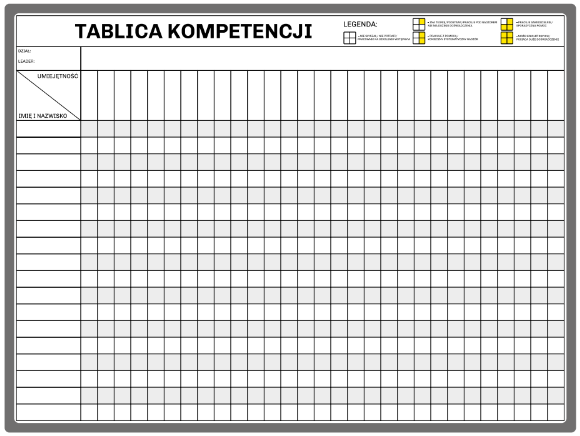
Competency boards, also known as competency matrices, are an invaluable workforce management tool. They help organizations understand their employees' skills, identify skill gaps, and plan team development. However, for such a board to be truly useful, it must be properly designed and visualized. In this article, we'll discuss how to create a competency board in a few simple steps that will aid in effective workforce management.
Step 1: Defining the Goal
The first step in designing a competency dashboard is to define its purpose. A dashboard can be used for a variety of purposes, including:
- Personnel management: Monitoring employee skills and identifying competency gaps.
- Development Planning: Creating development plans for employees and teams.
- Recruitment: Assessment of candidates in terms of required competencies.
- Training: Planning training and development programs.
- Employee motivation: Promoting development and promotions based on performance.
Clarifying the purpose will allow the board to be better tailored to the specific needs of the organization.
Step 2: Select Format
The next step is choosing a competency board format. Two options are most commonly used: magnetic boards and electronic competency management tools. The choice depends on the organization's preferences and needs. Magnetic boards are excellent for workplace visualization (GEMBA) and allow for easy updates. Electronic tools can be more flexible but require access to a computer.
Step 3: List of Employees and Competencies
Once you've defined your goal and chosen a format, prepare a list of all employees who will be included on the board. It's also a good idea to create a list of competencies that will be assessed. Not all competencies are necessarily equally important for all employees, so it's important to differentiate them.
Step 4: Grading Scale
The next step is to establish a rating scale that will help determine competency levels. The scale can be based on grades, percentages, or symbols. It's important that it's understandable to all employees and allows for clear assessment.
Step 5: Evaluate and Update
Only then can employees assess their competencies in the appropriate sections of the dashboard. It's advisable to include a self-assessment, which can help uncover employees' hidden abilities. After the self-assessment, the dashboards are reviewed and approved by their superiors. It's also important to establish a dashboard update frequency to monitor team development.
Step 6: Visualization and Additional Elements
To ensure a board is legible and useful, it's worth using various visual elements that make it more transparent and useful. These include:
- Markers that allow you to add and change information on dry-erase boards.
- Stickers that are intuitive and easy to use.
- Magnets that have the same advantages as stickers, and can also be used repeatedly.
- Magnetic clips are an interesting alternative to magnets, and their content can be easily changed.
- Prints that, although they cannot be edited, provide the greatest durability and legibility.
You can add photos to your employee list. This will also allow managers in other areas to easily identify experts or trainers without knowing their names.
Step 7: Using the Board
Ultimately, the competency dashboard becomes a tool for effective personnel management. It allows for the identification of competency gaps and the planning of training, promotions, and employee development. This tool motivates employees to develop and helps identify experts in various fields.
Summary
Competency dashboards are a flexible and versatile tool that can be tailored to the specific needs of an organization. By designing and visualizing them according to the proposed steps, we can effectively manage staff and create highly skilled teams.
Designing a useful competency dashboard is a process that requires careful attention and customization to the specific needs of an organization. However, investing in such a tool can yield enormous benefits in terms of personnel management and team development.